Showing posts with label Nonfiction. Show all posts

26 June 2020

Book Beginning: Sandwich: A Global History by Bee Wilson


Book Beginnings is a weekly meme hosted by Rose City Reader. We share the first sentence (or so) of the book we are reading, along with our initial thoughts about the sentence, impressions of the book, or anything else the opener inspires.
Portable, quick, satisfying, cheap and requiring neither plate nor cutlery, the sandwich is the most universal of all fast food, the archetypal hand-held snack.

Lately I have unearthed quite a few series of small, non-fiction books. "Sandwich" is from one called "Edible" with single-word titles such as: Milk, Pancake, Soup, Spices, Whiskey, and Chocolate. The publisher says:
Edible is a revolutionary new series of books dedicated to food and drink that explores the rich history of cuisine. Each book reveals the global history and culture of one type of food or beverage.

I think this will be perfect for light summer reading, although it might be hunger inducing!

07 May 2020

Common Sense about Language

Talk on the Wild Side: Why Language Can't be Tamed
Lane Greene
PublicAffairs, 2018
232 pages


For all you word people, this is a fantastic book! I loved it, plain and simple. Greene covers various topics, each showing, in a different way, why language can't be tamed, why it can't be put in a neat little perfectly logical box, with Rules. The range of topics can be deduced from the front blurb:

Samuel Johnson one said that "to enchain syllables, and to lash the wind, are equally the undertakings of pride." Nevertheless, many have tried: from sticklers for supposedly correct grammar to inventors of supposedly perfect languages; from software engineers working on machine translation to governments that see language management as politics by another means. But when you enter the lair of a wild beast, you may be lucky to escape with your wits intact. Join Lane Greene on a journey of discovery into the deep strangeness of language.

I'd heard of something called The Great Vowel Shift, but never could get my mind around the scant explanations I saw. He has a terrific explanation of how English vowel sounds moved away from the sounds in the rest of Europe. He shows this process using some examples from recent English.


 Another favorite chapter talks about how words start sticking together and changing over time. Again, I'd read that this has happened in the past, but never understood the process. He shows how we write things like "ought to work", "got to sleep", "have to run", and "going to try". But when we speak "the TO gets glommed on to the previous word": "oughta work", "gotta sleep", "hafta run", and "gonna try". If we had only spoken language, the actual words might start to change. Wow!

In a chapter entitled "Whom in a biker bar", Greene covers a large set of related topics such as various English dialects, Normal English vs. Formal English, how children learn their native language, and rules vs. preferences in grammar. There's an awful lot of information packed into that chapter, but I think the important ideas can be summed up by this paragraph:

The tricky cases that need to be taught explicitly to children in school belong almost exclusively to Formal. Normal is, by definition, what comes naturally to a native speaker. But Formal English includes all of the grammatical bits and pieces like whom, word order like the man about whom I was talking, and nominative case after the copula like it was she. These form part of the literary language that is a critical part of English-speakers' cultural heritage. Students need to learn Formal. But they should learn it for what it is: a specific kind of language for certain important purposes, and not the One Right Way. p. 173

This book is enlightening, funny, and wise, and I learned a lot about how we humans try to communicate. He also tweets out interesting tidbits, so you might want to follow him on Twitter, too: @lanegreene .


13 April 2020

Disease in the Bad Old Days

In the Wake of the Plague: The Black Death and the World It Made
Norman F. Cantor
Harper Perennial, 2001
245 pages


Talk about topical! Because I spent 16 years doing microbiological research, I have been interested in infectious diseases for a very long time, and I buy books on that topic whenever I unearth them in some dusty corner of a used book store. So, given the current covid-19 pandemic and lots of time, I grabbed this one off my shelf.

Let me say right off the top: this book will not help you to understand our world in the midst of the coronavirus pandemic. It can, however, help you to appreciate how far modern medicine has come in fighting infectious disease epidemics.


Cantor uses stories of historical individuals from the aristocracy, the gentry, and the peasants to personalize the devastation caused by the Black Death in the 1400s in England. I highly recommend looking at a listing of the kings and queens of England during that period. Much of the book involves the English court scene and I was totally lost without knowing the families involved. I found Wikipedia's "List of English monarchs" extremely helpful. I also copied out the relevant parts on paper so I could check back now and then. This in not to be taken as a flaw in the book! What the rulers were doing at that time had large implications for how the common folk were affected by the Black Death. And most of us just don't have a handle on royalty of the Middle Ages.

The book is structured in three parts. "Part 1 Biomedical Context" has an overview of the book and some discussion about the cause of the Black Death. There is a very interesting question raised: was it bubonic plague or was there another microbe involved?

In "Part 2 People", the longest section, he discusses what he calls the "microscopic closeup perspective" on the disease. He shows the many effects this disruption of society had on lawyers and property law, on women of the gentry class, and on science and religion. Interestingly he mentions anecdotal evidence that gentry males were hit harder that their womenfolk, a situation reflected in current covid-19 data.

"Part 3 History", the macroscopic perspective, has a fascinating discussion of alternate theories of where the plague came from and how it spread: other microbes? other vectors (animals)? outer space? The final chapter "Aftermath" has a wide-ranging discussion of the many ways the Black Death changed European society in the Middle Ages. This is followed by a bibliography divided into various topics brought up in the book. If you get seriously intrigued by this plague or this era of European history, you will find lots of further reading.

I am glad I read this book as it has given me a better picture of life in the European Middle Ages during the Black Death. And it makes me profoundly grateful for modern science and medicine.

This is part of my reading for the 2020 Mount TBR Challenge.


FURTHER READING

Plagues and Peoples by William H. McNeill (1976)
Upon its original publication, "Plagues and Peoples" was an immediate critical and popular success, offering a radically new interpretation of world history as seen through the extraordinary impact – political, demographic, ecological, and psychological – of disease on cultures. From the conquest of Mexico by smallpox as much as by the Spanish, to the bubonic plague in China, to the typhoid epidemic in Europe, the history of disease is the history of humankind. -from the publisher

I loved this book which I read when it was new. Might be time for a re-read!

10 April 2020

Book Beginning: On The Art of Reading by Arthur Quiller-Couch

http://www.rosecityreader.com/

Book Beginnings is a weekly meme hosted by Rose City Reader. We share the first sentence (or so) of the book we are reading, along with our initial thoughts about the sentence, impressions of the book, or anything else the opener inspires.

In the third book of the "Ethics", and in the second chapter, Aristotle, dealing with certain actions which, though bad in themselves, admit of pity and forgiveness because they were committed involuntarily, through ignorance, instances 'the man who did not know a subject was forbidden, like Aeschylus with the Mysteries,' and 'the man who only meant to show how it worked, like the fellow who let off the catapult' ([Greek: e deixai Boulemos apheinai, os o ton katapelten]).

OK, so this is going to be a bit of a challenge, not easy stuff! I have read that it gets much less high-brow as he goes on with the lectures. An article in The Cambridge Quarterly of September 2014 says:

Vast numbers of self-help readers after the First World War were keen to develop their literary taste and gain confidence in navigating their way through the literary field; Quiller-Couch's innate understanding of this "new reading public" accounts for the extraordinary success of his published lectures.

It's always good to have a meaty book in the current reading pile!


REFERENCE
Alexandra Lawrie, "Arthur Quiller-Couch, Taste Formation and the New Reading Public", The Cambridge Quarterly, Volume 43, Issue 3, September 2014, Pages 195–211,
https://academic.oup.com/camqtly/article/43/3/195/270666


27 March 2020

Book Beginning: In the Wake of the Plague by Norman F. Cantor

Book Beginnings is a weekly meme hosted by Rose City Reader. We share the first sentence (or so) of the book we are reading, along with our initial thoughts about the sentence, impressions of the book, or anything else the opener inspires.

In the sixth month of the new millennium and new century, the American Medical Association held a conference on infectious diseases. Pronouncements by scientists and heads of medical organizations at the conference were scary in tone. Infectious disease was the leading cause of death worldwide and the third leading cause in the U.S.A., it was stressed. The situation could soon become much worse.

As the world becomes more of a global village, said one expert, infectious disease could by natural transmission become more threatening in the United States. Here monitoring is lax because of a mistaken belief that the threat of infectious disease has been almost wiped out by antibiotics.


Whew. Talk about timely! I've had this book for quite a while now because as a former microbiologist I am very interested in the history of disease. The subtitle of the book is "The Black Death & The World It Made". Hence I thought it would be of historical interest. Now I'm thinking it might be more relevant to today's problems. We shall see.

04 March 2020

Linguistic Diversity

Languages: A Very Short Introduction
Stephen R. Anderson
Oxford University Press, 2012
135 pages


This book is part of Oxford University Press's "A Very Short Introduction" series, now 691 books strong. From Abolitionism to Zionism, from Lincoln to Rousseau, from Advertising to Sleep, and everything in between is discussed in a very accessible way in about 125 pages each. I read "Italian Literature" a couple years ago and enjoyed it, so now I'm searching out more on topics I am curious about, where I don't want to digest an entire 500-page tome on the topic.


I find it hard to summarize this type of book, so I'm giving you the publisher's blurb about it:

How many languages are there? Are new languages still being discovered? Why are so many languages disappearing? In this Very Short Introduction, eminent linguist Stephen Anderson addresses such questions as he illuminates the science behind languages. Considering a wide range of different languages and linguistic examples, Anderson provides the basic facts about the world's major families of spoken languages and their distribution around the globe. He explores the basis for linguistic classification and raises questions about how we identify a language. Considering signed languages as well as spoken, Anderson also examines the wider social issues of losing languages, and their impact on vanishing cultures and peoples.

The discussion about how many languages there are was fascinating. I never realized how hard it is to count them. Anderson gives a lot of analogies to biological systems that are more familiar than linguistic ones, and that helps clarify many of his points.

The section about signed languages is also very enlightening. Unless you happen to know a deaf person who signs, you probably don't understand how signing works as a language - I know I didn't. This is necessarily a very broad introduction, but it gives me a context for other language-related topics I encounter.


06 February 2020

Book Beginning: What's Your Pronoun? by Dennis Baron


Book Beginnings is a weekly meme hosted by Rose City Reader. Share the first sentence (or so) of the book you are reading, along with your initial thoughts about the sentence, impressions of the book, or anything else the opener inspires.

Pronouns are suddenly sexy. They're in the air, on the news, all over social media, generating discussion pro and con. Or at least one pronoun is: the third-person singular gender-neutral pronoun. Yes, the pronoun without sex is suddenly sexy.


I think it was when I read this intriguing blurb from the publisher that I decided to look at this book:
The book, based on forty years of empirical research by renowned linguist Dennis Baron, tells a history that delves not only into our current environment but also into past attempts to come up with gender-neutral and nonbinary pronouns -- from generic he to singular they to coined words like ze and hir and hizzer.

Ze? Hizzer? A must read!  And I don't think this book will disappoint, because when leafing through it, I discovered the last chapter is called "A Chronology of Gender-Neutral and Nonbinary Pronouns" and it is 60 pages long! The first 1-2/3 pages are text, but the rest is dated short paragraphs with lists of gender-neutral pronouns, starting in 1770.


07 December 2019

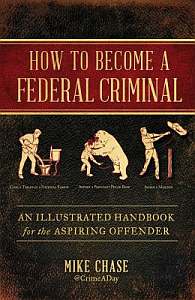
Book Beginning: How to Become a Federal Criminal by Mike Chase

http://www.rosecityreader.com/

Book Beginnings is a weekly meme hosted by Rose City Reader. Share the first sentence (or so) of the book you are reading, along with your initial thoughts about the sentence, impressions of the book, or anything else the opener inspires.

If you're like most Americans, your first experience with the heart-pounding thrill of committing a federal crime came from a little white tag on the end of your mattress.
"Cut me," it dared you. "Tear me off."


I am greatly looking forward to reading this provocatively-titled book. Full title: "How to Become a Federal Criminal: An Illustrated Handbook for the Aspiring Offender". I've been following the author on Twitter - @CrimeADay - and the daily crime tweets have been very entertaining!

15 November 2019

Book Beginning: Dear Friend by Gina L. Mulligan


Book Beginnings is a weekly meme hosted by Rose City Reader. Share the first sentence (or so) of the book you are reading, along with your initial thoughts about the sentence, impressions of the book, or anything else the opener inspires.


Letters are sacred mementos we lovingly save in decorative boxes, memories captured to relive again and again. Yet the gentle beauty of a handwritten letter seems largely forgotten in our age of text messages and emails. After working for five years on a novel comprised entirely of letters, I felt connected to what I consider the lost art of letter writing. However, not until I was diagnosed with breast cancer did I understand that a few words on paper are more than a keepsake. A handwritten letter is a gift with the ultimate power to heal and inspire.

The subtitle says it all: "Letters of Encouragement, Humor, and Love for Women with Breast Cancer". Written by compassionate strangers—many of whom have gone through their own health battles—these heartfelt letters contain empathy, inspiration, and humor to help you overcome difficult moments. They were gathered by Girls Love Mail, an organization that provides support to people diagnosed with breast cancer.


11 November 2019

To Semicolon or Not to Semicolon

Semicolon
The Past, Present, and Future of a Misunderstood Mark
Cecelia Watson
Harper Collins, 2019
213 pages


I was amused to find a whole book written about one little punctuation mark, and purporting to present its history no less. Ordinarily one does not worry about a punctuation mark's past, just how it should be used now. So, being the word nerd that I am, I had to check it out.


Venice, 1494: Aldus Manutius, printer and publisher, decides to put a comma and a colon together, thereby creating a mark for a mid-length pause, shorter than a colon, longer than a comma. In those days grammar rules had not yet been created and codified and it was every writer/printer/publisher for themself! The marks were often thought of as denoting pauses for reading passages aloud; pauses that would help convey the meaning of the words.


The author follows the semicolon from its birth through subsequent centuries of use and controversy. It is quite amazing how many people have passionate reactions to the mark, both pro and con, even into the twenty-first century! Many examples of how it's used are given, with quotes from works by Milton, Martin Luther King Jr, Raymond Chandler, and Herman Melville.

"Moby-Dick", a favorite novel of mine, is discussed in a long section of the chapter "Semicolon Savants". Apparently Melville's famous book contains about 210,000 words with 4,000 semicolons.

The semicolons are "Moby-Dick's" joints, allowing the novel the freedom of movement it needed to tour such a large and disparate collection of themes. page 36.

Despite the eye-catching title, most of the book is about grammar rules, how we got them, the so-called Grammar Wars, and the edicts of style guides like the "Chicago Manual of Style". That list may sound dry and academic, but the text is lively and has fun examples. If you are fascinated by words and how they are used, or confused by grammar rules, this book should entertain you.


13 September 2019

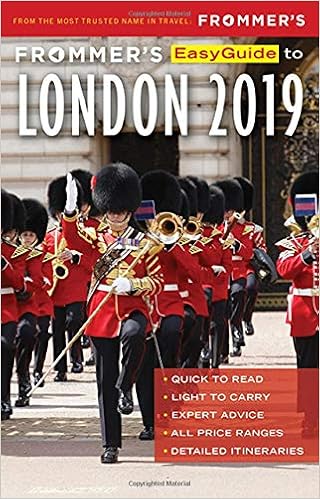
Book Beginning: Frommer's EasyGuide to London 2019 by Jason Cochran


Book Beginnings is a weekly meme hosted by Rose City Reader. Share the first sentence (or so) of the book you are reading, along with your initial thoughts about the sentence, impressions of the book, or anything else the opener inspires.
Whether you realize it or not, London shaped your destiny. There's hardly a corner of the globe that London, as the seat of England's government, hasn't changed.


I'm in London this week for my Vacation Beginning and I've read nearly all of this book. I checked it out of the library first and to me it was much better than the other London book I had already bought, so I bought my own copy of it. It spends less time on finding accommodations and more on letting you enjoy your trip. Recommended for your next trip.

06 September 2019

Book Beginning: Europe Through the Back Door by Rick Steves

http://www.rosecityreader.com/

Book Beginnings is a weekly meme hosted by Rose City Reader. Share the first sentence (or so) of the book you are reading, along with your initial thoughts about the sentence, impressions of the book, or anything else the opener inspires.

Eating in Europe is sightseeing for your taste buds. Every country has local specialties that are good, memorable, or both.


I'm cheating a bit this week. All I'm reading is travel tip because I leave on a vacation to England and Ireland soon. So this is the first two sentences from the chapter called "Eating" in this very useful Rick Steves book which has the subtitle "The Travel Skills Handbook". Great preparation for going to Europe and enjoying your trip, whether you've been there before or are on your very first trip abroad. Highly recommended!


31 August 2019

Book Beginning: Linguistics: Why It Matters by Geoffrey K. Pullum


http://www.rosecityreader.com/

Book Beginnings is a weekly meme hosted by Rose City Reader. Share the first sentence (or so) of the book you are reading, along with your initial thoughts about the sentence, impressions of the book, or anything else the opener inspires.

An extraterrestrial zoologist observing our planet's wildlife a few hundred thousand years ago might well have been puzzled. The strange, soft-skinned, almost hairless primates that had emerged over the previous million years did not initially look like a good evolutionary bet, but they were doing incredibly well.


This book is part of a series called "Why It Matters" in which leading thinkers make a case for the importance of their subjects. I've been interested in linguistics for a while, but I don't really understand what subjects it covers. I'm hoping to understand it much better after reading this little book.

16 August 2019

Where Can I Find a Bubbler?

Speaking American
*How Y'all, Youse, and You Guys Talk.
A Visual Guide
Josh Katz
Houghton Mifflin Harcourt, 2016
203 pages


This book delves into regional differences in the terms we use in everyday American English, colorfully mapping the variations. And since the book is oversized, 10" x 9.5", it makes for maps that are easily read.


Some differences in terminology are widely known, such as the terms for canvas shoes with rubber soles: Tennis shoes, sneakers, or gym shoes. Apparently where I grew up, Milwaukee, and where I live now, Cincinnati, are both in a tiny minority of gym shoe users. Some I knew about but I didn't know all the options: Italian sandwich, sub, hoagie, grinder, hero, or wedge. Wedge?

The maps are accompanied by discussions about the words, sometimes a history of a term, or other interesting information about how and why we don't all speak alike. In addition there are paragraphs about many individual states with the flavor of "if you say this - then you are from here".

As someone who spent their first 30 years in Wisconsin, the overall summary of its words didn't quite ring true to me, but most of the Milwaukee area's verbal tics seen on the maps seemed spot on. First up, we do pronounce the state as Wi-scon'-sin not Wis-con'-sin.  When I lived in Washington, D.C., someone actually tried to correct how I pronounced "Wisconsin Avenue"! I told them that as a Wisconsinite, I said it correctly by default.

Although most of the US and Wisconsin call the tiny, sugary bits topping cupcakes "sprinkles", those of us from the Milwaukee area lean toward "jimmies" along with a lot of New Englanders. Our most famous word is probably "bubbler". You know, that porcelain fixture where you can get a drink of water? Sure, the rest of you know it as a "water fountain" or a "drinking fountain", but in most of Wisconsin (and a tiny part of Rhode Island) it's a "bubbler".


The most surprising thing for me was that there are different ways to pronounce the word "crayons". It can be krey'-awns, krey'-ahns, krowns, or krans. Turns out our "krans" is mostly found in the Milwaukee area, large swaths of Michigan and Minnesota, and the Buffalo area of New York state. My parents lived in Wisconsin and Michigan, and my mom was from Buffalo. So interesting!

This is a fun and informative read, with more visuals than words. If you are at all curious about words and language, you would enjoy this book.


Book Beginning: Speaking American by Josh Katz


http://www.rosecityreader.com/

Book Beginnings is a weekly meme hosted by Rose City Reader. Share the first sentence (or so) of the book you are reading, along with your initial thoughts about the sentence, impressions of the book, or anything else the opener inspires.

It used to be that if you wanted something to wear on your feet, your only option was expensive handcrafted leather.


The sub-title of this fun book might give you a better hint of its subject: "How Y'all, Youse, and You Guys Talk, a Visual Guide". Using many colorful maps of the United States, the author delves into regional differences in the terms we use in everyday American English. The opening sentence begins a discussion about canvas shoes with rubber soles. Tennis shoes? Sneakers? Gym shoes? Or my friend Don's term, Tenniebops? (And in England they're trainers.)

10 August 2019

Book Beginning: The Goshawk by T. H. White


http://www.rosecityreader.com/

Book Beginnings is a weekly meme hosted by Rose City Reader. Share the first sentence (or so) of the book you are reading, along with your initial thoughts about the sentence, impressions of the book, or anything else the opener inspires.

When I first saw him he was a round thing like a clothes basket covered with sacking. But he was tumultuous and frightening, repulsive in the same way as snakes are frightening to people who do not know them, or dangerous as the sudden movement of a toad by the door step when one goes out at night with a lantern into the dew.


Here T. H. White is describing his first sight of the goshawk he has just purchased, later to be named Gos. It's a short book, but has a lot of humor as White tries very hard to train Gos to hunt with him. I am reading it after seeing it mentioned in "H is for Hawk" by Helen Macdonald.


12 July 2019

Book Beginning: The Prodigal Tongue by Lynne Murphy


Book Beginnings is a weekly meme hosted by Rose City Reader. You are asked to share the first sentence (or so) of the book you are reading, along with your initial thoughts about the sentence, impressions of the book, or anything else the opener inspires.

"If there is a more hideous language on the face of the earth than the American form of English, I should like to know what it is!"  Baron Somers, in the House of Lords (1979)
Americans are ruining the English language. I know this because people go out of their way to tell me so. I am a magnet for such comments - an American who dares to teach English Language and Linguistics at a British university and who has the chutzpah to write about American and British languages differences on the internet.


What a fun start! I love books about English and British English. When I first visited Britain I discovered our languages are maybe 75% the same. Sure, we use most of the same words, but the Brits use some of them differently than we do, and they pronounce some quite oddly, too. And then there is "gobsmacked", "chuffed", and "fairy liquid". I'm chuffed to be reading this book before my fall trip to Britain!


01 July 2019

Urban Pigment Foraging

 Make Ink: A Forager's Guide to Natural Inkmaking
 Jason Logan; conversation with Michael Ondaatje
 Abrams, 2018
 191 pages


With a background in chemistry and a love of both colorful arts and crafts and fountain pen inks, this book reached out and grabbed me from the start. It's a combination of a coffee-table book with gorgeous pictures, an ink-making recipe book, and a study of the culture of inks and colors.


The forward is by Michael Ondaatje, the Sri Lanka-born Canadian author of "The English Patient" and other works. As someone who even now writes all his first drafts with pen and ink, he felt compelled to meet the ink maker. He writes of their meeting:
We sat down in his kitchen and it felt like being introduced to someone with the skills of some lost medieval craft. What he did seemed a blend of alchemy with foraging and some possibly illegal art of cooking.
At the end is a transcription of a conversation between Logan and Ondaatje. They talk of foraging, the relationship between words and drawings, strange old techniques of ink making, and ink making around the world.

The publisher's description of the book:
The Toronto Ink Company was founded in 2014 by designer and artist Jason Logan as a citizen science experiment to make eco-friendly, urban ink from street-harvested pigments. In "Make Ink", Logan delves into the history of inkmaking and the science of distilling pigment from the natural world. Readers will learn how to forage for materials such as soot, rust, cigarette butts, peach pits, and black walnut, then how to mix, test, and transform these ingredients into rich, vibrant inks that are sensitive to both place and environment. Organized by color, and featuring lovely minimalist photography throughout, "Make Ink" combines science, art, and craft to instill the basics of ink making and demonstrate the beauty and necessity of engaging with one of mankind's oldest tools of communication.
Having read about producing black walnut ink before, I was expecting natural ink making to involve plant parts and maybe a few chemical stabilizers. What I didn't expect was that urban detritus could turn into ink as well. But Logan see possibilities everywhere in the urban environments around him. From pieces of rusty metal to copper wires to pieces of drywall, he is willing to try them all. Of course, most of the pigments in the recipes do come from nature - acorns, oak galls, pokeberries, and grape vines all contribute their colors, often in surprising ways. Dark purple buckthorn berries result in green ink!

The last section presents images created with his inks by many artists and writers to whom he sent samples. In addition, throughout the book there are stunning full-page pictures of his ink testings and paintings. There are some examples of writing, but note that this type of ink is not for use in fountain pens, only with dip pens or brushes.

This is a fascinating book, even if you don't plan on harvesting rusty bedsprings from beside the roadways in your town. After reading it, the produce at the farmers' market and the herbs and spices in my kitchen cupboards began to look like ink ingredients to me. And I'm sure there will be plenty of acorns and black walnuts around this fall. Some experimenting of my own is coming soon!


Further Reading

The publisher, Abrams, has images from the book here:
https://www.abramsbooks.com/product/make-ink_9781419732430/

18 May 2019

Titles and Entitling

Now All We Need is a Title
André Bernard
WW Norton, 1994
127 pp.

Subtitled "Famous Book Titles and How They Got That Way", this is an entertaining little book full of anecdotes about the process of titling a book. There is no narrative as such, just vignettes organized by the authors' names plus some lists of thematically-related titles, such as "numbers in titles" or "planets and moons in titles". Scattered throughout are black-and-white illustrations which appear to be from very old books and bookplates.


Some stories are told by the authors themselves or their editors, a few are quotations from a book wherein the character talks about creating a title. I found many interesting titbits, like the fact that E.E. Cummings published a book in 1930 with no title at all, and Fitzgerald's working title for "The Great Gatsby" was the amazingly clunky "Trimalchio in West Egg"!

In the only known instance of a book's title predicting its fate, the first printing of John Steinbeck's 'The Wayward Bus' was destroyed when the truck transporting the books from the bindery crashed in flames. The truck had been hit by a "wayward" bus that had been traveling down the wrong side of the road. p. 106

It was Lewis Carroll who came up with the idea of putting the title on the dust jacket, and his 'The Hunting of the Snark' was the first book to be published with a printed jacket in 1876.

If you love books and the stories behind them, this is the book for you. The format makes it perfect for dipping into at odd times, when your current read (or life) is getting a bit heavy.

NOTE:
Trimalchio is a character in the 1st century AD Roman work of fiction "Satyricon" by Petronius. He is an arrogant former slave who has become quite wealthy by tactics that most would find distasteful. -Wikipedia


18 March 2019

Attention: Bibliophiles!

Bibliophile: An Illustrated Miscellany
Jane Mount
Chronicle Books, 2018
224 pp.


As if it weren't bad enough that I love books, I must confess to a love of books about books! And I suspect I am not alone. If one has a bookish obsession, then anything that feeds that obsession is... good? must have? welcomed? a disaster waiting to happen? all of the above?

https://amzn.to/2TaoPJ3

And now we have "Bibliophile". This book needs a mini book jacket like those I've seen on Japanese books. I don't know what the Japanese ones say, but this one should have a warning message:
Caution: Reading this book will increase your TBR stack by 100% or more!

In fact Ms. Mount even states: "The goal of this book is to triple the size of your To Be Read pile."

The author is a talented illustrator, and the pages are filled with charming drawings of book covers or book piles, the authors, stores, cats, and everything else Book. Besides sections on many different book genres, there are ones on such topics as Striking Libraries, Beloved Bookstores, Store Cats, the Writing Rooms of various authors, and Little Free Libraries.

This is eye candy for all bibliophiles, and it's not so much to be read cover-to-cover as to be dipped into and savored frequently. Be sure to keep note-taking accessories nearby, as you will surely want to read many of the recommended titles!


FURTHER READING

A very generous number of pages are available for viewing on Amazon.com as part of their Look Inside program. Take a peak! https://amzn.to/2TaoPJ3

Jane Mount's website for the book
https://janemount.com/bibliophile-an-illustrated-miscellany/