Showing posts with label Back to the Classics 2020. Show all posts

17 June 2020

Some Current Reads


It's a few days late for it, but here's my entry for June's Quick Lit, a monthly meme on the Modern Mrs. Darcy blog. The creator is Anne Bogel, who explains that Quick Lit is where "we share short and sweet reviews of what we’ve been reading lately on the 15th of the month".


Translation: A Very Short Introduction by Matthew Reynolds

This is another book in Oxford University Press's A Very Short Introduction series, now 689 books strong. From Abolitionism to Zionism, from Lincoln to Rousseau, from Advertising to Sleep, and everything in between is discussed in a very accessible way in about 125 pages each.

So far I've read "Italian Literature", "Languages", and now "Translation". I find this series perfect for dipping a toe into a subject without digesting an entire 500-page tome on the topic. Each book has sections on references and further reading, in case I want to pursue that topic further.

I have been reading more literature in translation recently, and wanted to know something about the processes and issues involved. I find it hard to summarize this type of book, so I'm giving you the publisher's blurb about it:
In this Very Short Introduction, Matthew Reynolds gives an authoritative and thought-provoking account of the field, from ancient Akkadian to World English, from St Jerome to Google Translate. He shows how translation determines meaning, how it matters in commerce, empire, conflict and resistance, and why it is fundamental to literature and the arts.
Reading this slim volume helped me to better appreciate the translated novels I've been reading.
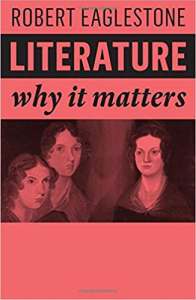


Literature: Why It Matters by Robert Eaglestone
Polity 2019

I enjoy these small books about big topics, and the Why It Matters series from Polity Books is another good source of quick, distilled information. The literature topic is very complex, more than I'd imagined. I did like this volume, but, again, cannot easily tell you what it's about. I'll let the publisher explain it:
"Facts alone are wanted in life," exclaims Mr Gradgrind at the beginning of Dickens' Hard Times. Literature is not about facts alone, and – despite two and a half thousand years of arguments – no one can agree on what it is, or how to study it. But, argues Robert Eaglestone, it is precisely the open-ended nature of literature that makes it such a rewarding and useful subject.
Eaglestone shows that studying literature can change who you are, turning you from a "reader" into a "critic": someone attuned to the ways we make meaning in our world. Literature is a living conversation which provides endless opportunities to rethink and reinterpret our societies and ourselves. With examples ranging from Sappho to Skyrim, this book shows how literature offers freer and deeper ways of thinking and being.

The whole series is worth reading, and this one only has 12 books!


Season of Migration to the North by Tayeb Salih
Translated by Denys Johnson-Davies
Heinemann, 2008
Originally published in Arabic, 1966

I had high hope for this short novella. It's another of my finds in the clearance section at my local used bookstore. I had not heard of the author before, but the influential literary critic Edward W. Said proclaimed this novel to be "among the six finest novels to be written in modern Arabic literature". It also fit into my plan to read more translated literature.

One of the glowing reviews, in the The Observer (London), had this to say:
An "Arabian Nights" in reverse, enclosing a moral about international misconceptions and delusions. This is the story of a student who returns to his village after his obsession with the West had led him to London and the beds of women with similar obsessions about the mysterious East...Powerfully and poetically written and splendidly translated by Denys Johnson-Davies.
The first 2/3 of the book was very interesting, the prose lyrical and readable. The descriptions of the Sudanese men in London and the Londoners' impressions of the Sudanese men are well written, and perhaps especially enlightening in the current era of trying to understand racial bias. But then it veered off into violence and the grotesque. I did finish it, but overall I would say I did not like this book. I don't like violent, grotesque movies or TV shows either. Maybe if you can think of it all as allegory you would like it.

This is my entry in the Classic in Translation category for the 2020 Back to the Classics challenge. It's also part of my reading for the 2020 Mount TBR Challenge.


16 April 2020

The Debut of M. Hercule Poirot

The Mysterious Affair at Styles
Agatha Christie
William Morrow, 2020 Kindle Edition
Originally published 1920
269 pages

I read a classic Agatha Christie for the 1920 Club, presented by Simon at Stuck in a Book and Karen at Kaggsy's Bookish Ramblings. Years ago I listened to the audiobook version of this, the first in the Hercule Poirot series, but I had no memory of the story.

Reading this book now, I took delight in the many details of M. Poirot's appearance, mannerisms, and quirks. Of course I was comparing them to the wonderful TV portrayal of Poirot by David Suchet, and I think the shows were faithful to the original character, always an important issue for me.


Not to give away the plot, but Poirot does solve the murder, which involves a poisoning in a locked room and lots of suspicious relatives. This was Christie's first mystery, and it was turned down by six publishers before being published in 1920. I was quite surprised that this was her first published novel. The characters seem well-defined and the plot logical without annoying loose ends. She had, however, written one earlier novel that was rejected and never published.

This Kindle version of the William Morrow paperback includes two short articles by Christie where she explains how Poirot came to be and her relationship to him over the years. Very interesting!

Now I think I will continue to read more of Poirot. There are 33 novels, 2 plays, and more than 50 short stories in the Poirot canon. Plenty to keep me busy.

The is my entry in the Classic Adaptation category for the 2020 Back to the Classics challenge. It was adapted as part of the long-running Poirot TV series.


11 March 2020

A Miniature Victorian Novel

The Young Visiters or, Mr. Salteena's Plan
Daisy Ashford
Academy Chicago Publishers, 1991
First published 1919
102 pages


Nine-year-old Daisy Ashford's novella is a lot of fun to read, childish errors of spelling and punctuation and all. It's both short and entertaining enough to be read in a single pass. And if you are at all attuned to novels or TV dramas about the English aristocracy of 100 years ago, it is also quite funny, akin to P. G. Wodehouse's Jeeves and Wooster stories.


Walter Kendrick. a professor of English at Fordham University who was an authority on Victorian literature, assures us in his introduction that this is not just a children's story, but "also a Victorian novel in miniature, a tidy précis of English fiction circa 1890". It even has a double plot, one about love, the other adventure.

As for Ashford's spelling and punctuation, he calls them "hilariously idiosyncratic". She may talk about the "sumpshous" bathroom, items wrapped in "tishu paper", and a room full of "searious people", but she knows what those words mean and tries her best to spell them phonetically. Hey, she's nine!


According to Wikipedia, "The Young Visiters" has been adapted as a musical, a play, a feature-length movie, and a BBC television production. Not bad for a first-time author!

The is my entry in the 20th Century Classic category for the 2020 Back to the Classics challenge.


26 February 2020

Industrial Poverty

Mary Barton: A Tale of Manchester Life
Elizabeth Gaskell
Penguin, 1986 (first published 1848)
487 pages


"Mary Barton" tells the story of four Manchester families, but ultimately it's the story of the industrial poverty in Manchester, England, during a period that later came to be known as the "hungry forties". During the 1840s bad harvests, economic depression, and other issues led to severe poverty and hunger for the working class in Manchester, the heart of England's Industrial Revolution.

Mrs. Gaskell gives a very realistic portrayal of the impoverished workers and their families as they struggled to survive in squalid slums: very little clothing, shacks that were damp and drafty, little firewood for heat or candles for light, almost no food, children starving to death or freezing to death. Her scenes of everyday life are quite detailed and quite often grim. In this urban realism style she also shows us the prisons, courts & lawyers, the hostile relationship between workers and factory owners, and the nascent trade union movement.


The main plot follows the lives of two families of mill workers, John and Mary Barton and their daughter Mary; and their friends George and Jane Wilson, son Jem, and George's sister Alice. Another family is also important, young Mary's friend Margaret Jennings and Margaret's grandfather, Job Legh. All three families are beset by poverty, disease, and death during the story. A fourth family is less talked about but pivotal to the plot: the wealthy mill owner John Carson, Mrs. Carson, and their son Harry.

In the first half of the book we see the extreme conditions in Manchester's poor neighborhoods and learn about the grievances of the workers against the mill owners. It's mostly the story of John as he becomes more and more bitter about his life and joins the trade union. A murder happens and the second half of the book is the tale of young Mary's efforts to prove the man she loves is innocent of the crime. The first half is taken up with lots of atmosphere and the plight of the poor. Then, having established the background, the rest is more of a murder mystery. There is a happy ending for some of the characters, although it involves a rather contrived plot device, pretty much a deus ex machina.

Like many other Victorian novels, it is long with a complicated plot. Is has lots of those long, involved sentences that were in vogue then, the type that require re-reading to understand. But it was not difficult to read and I enjoyed the story. Mrs. Gaskell was very gifted in the way she wrote about the characters' feelings. Sometimes I had to take a break because I was so caught up in the story and was anxious about what would happen next.

Luckily this large book does not have a cast of thousands like some. I found it easy to keep track of who was who, unlike in Anthony Trollope's "Can You Forgive Her" when I had to draw family trees to follow the many characters. Because the British historical background is pertinent to understanding the story, I was happy to have an annotated edition that explained the cultural references which are opaque to us today.

Elizabeth Gaskell is a writer that is perhaps overlooked by today's readers of classic novels, and I think that is a mistake. This was the first of her six novels and was very well-written. She also wrote a biography of her friend Charlotte Bronte, which The Guardian named one of the 100 best nonfiction books of all time in 2017.


The is my entry in the 19th Century Classic category for the 2020 Back to the Classics Challenge and it's also part of my reading for the 2020 Mount TBR Challenge.


10 February 2020

Black or White in 1920s America

Quicksand / Passing
Nella Larsen
Rutgers University Press, 1995  (first published 1928, 1929)
246 pages


I discover some of my very best reads from book blogger reviews, and this book is no exception. Of course I don't know who it was, but here's a general "Thank you!" to all who are avid readers and bloggers.

This book contains two novellas written by a woman who was an acclaimed novelist of the Harlem Renaissance of the 1920s. Appropriately (and accidentally) February is Black History Month.


In "Quicksand" the main character, Helga Crane, shares some biographical details with the author. Both are half Black and half Danish. Both grow up in Chicago with a White stepfather who doesn't like that they are half Black. Both lived in the deep South, Harlem, and Denmark. Larsen's life story is a bit sketchy, but it does not follow Helga's exactly. Their shared experiences, though, do mean that Larsen could easily draw her characters and their milieu realistically.

During the story, Helga moves from somewhere outside Atlanta to Chicago, then Harlem in New York, Denmark, and back to Harlem. She never feels she belongs anywhere, with Blacks or Whites. She seems rather aloof and has no close friends. She also doesn't know what she wants; a few years after she gains an objective and thinks she is finally happy, she become dissatisfied and restless again.

The plot thus far seems believable to me, but it then takes a dramatic turn which I found totally unconvincing. Helga has a sudden, intense religious conversion during a gathering she happens upon at a low point in her life. She makes another impulsive move, ending up in rural Alabama, impoverished, ill, unhappy again, and basically "barefoot and pregnant".

I can accept that she might have a deep religious conversion, but not the degradation she subjected herself to afterwards. She had always been so fastidious, cool and analytical, ambitious, a lover of nice things, semi-fluent in Dutch. Maybe I don't understand such a conversion because I've never experienced one.

The second story, "Passing" is much shorter but very interesting. Two Black women who were childhood friends meet accidentally in Chicago. One leads a conventional life, married to a Black doctor with two children. The other one is married with one child but is passing for White; even her White husband doesn't know the truth. And he is a rabid racist.


I enjoyed both novellas with their detailed descriptions of people and places, evoking life in the 1920s in America and Denmark. Both stories highlight the experiences of Black women in Black society and in White. The depiction of the characters' inner lives is captivating and vivid. On the back cover the publisher writes:

As noted in the editor's comprehensive introduction, Larsen takes the theme of psychic dualism, so popular in Harlem Renaissance fiction, to a higher and more complex level, displaying a sophisticated understanding and penetrating analysis of black female psychology.

I highly recommend reading both of these novellas, which are often published together in one volume.

The is my entry in the Classic by a Person of Color category for the 2020 Back to the Classics challenge and it's also part of my reading for the 2020 Mount TBR Challenge.


FURTHER READING

Nella Larsen
Black History Now: Black History Biographies from the Black Heritage Commemorative Society
http://blackhistorynow.com/nella-larsen/

Passing, in Moments: The uneasy existence of being black and passing for white.
Words by Mat Johnson
Topic Magazine
https://www.topic.com/passing-in-moments

20 January 2020

Growing Out of Bachelorhood

Bachelor's Bounty
Grace S. Richmond
A. L. Burt Co, 1932
306 pages


I bought this book at a used bookstore because it was by a woman author in the 1930s. As a regular reader of Scott's Furrowed Middlebrow blog, I am intrigued by reading novels by female authors between WWI and WWII. It's an interesting time in history as many parts of everyday life had recently changed or were just about to change. So these novels show us the way things were at that time.

Our titular bachelor (confirmed) is Scott Farrington, a New York City native with enough money to live the high life without working: drinking to excess throughout Prohibition, partying, carousing, travelling first class on ocean liners. In his thirties he was hospitalized for months with a serious illness and almost lost his eyesight.


As the story opens, Scott is moving to the country for a year on his doctor's orders, to dry out and calm his nerves. He settles in a small Connecticut hamlet in an old rundown house on the river, planning on writing a play. His next door neighbors are a 45-year old invalid and his 24 year old daughter-caretaker. Unlike the rest of the country folk, Jeremiah and Barbara Keane are well-educated, thoughtful, and very engaging people.

Soon his life gets complicated when Caroline, the glamorous widow of his best friend, abruptly decides to go off to Egypt and leave her 6-year-old son with Scott. An interesting new neighbor, a small and gossipy hamlet, a small boy who must be accounted for, and various people from his New York City social set flitting in and out of his house set the stage for the drama. Not to give away the story, but in the end Scott realized he has grown up a lot, plus there's a happy ending for him.

As for the title, it doesn't refer to Scott having several women in his life as I first thought. Somewhere he muses about the phrase "bachelor's bounty" and says it means that as a bachelor he is committed to a life of giving presents to all his married friends' children. I can't find that quote now, of course.

Last Page


Despite rather mediocre writing, I enjoyed the book. After a few chapters it suddenly seemed like the script for a 1930s movie. I saw Cary Grant in the lead, Audrey Hepburn as the ingénue next door, maybe John Barrymore as her dad, Jean Harlow as Caroline. It really should have been made into film back then.

Grace S. Richmond wrote 27 novels between 1905 and 1936, some of which my library has, so I might try out another one. I'd like to see if she makes other independent women out to be heroines. This book would not be mistaken for feminist literature, but the sensible, intelligent woman is shown as much more desirable than the flighty one who trades on her looks and is a drama queen.

The is my entry in the Classic by a Woman category for the 2020 Back to the Classics challenge  and it's also part of my reading for the 2020 Mount TBR Challenge.


08 January 2020

Joining 2020 Back to the Classics Challenge


Huzzah! Karen at her KarensBooksAndChocolate blog is once again hosting the Back to the Classics Challenge in 2020! And I am jumping right in because it helps me actually plan and read books that I already own. It was the very first book challenge I ever found, and my favorite.

Read 1 book from each of the 12 given categories in 2020, review them online, and link back to Karen's blog. I'm going to list my picks and some alternates now. However you are allowed to change them around or read entirely different books, as long as you straighten it all out by year's end. These are all residents of my bookshelves, so I plan on sticking to the list and reducing my TBR lists somewhat.

Here goes!

1. 19th Century Classic. Any classic book originally published between 1800 and 1899.
    Innocents Abroad, Mark Twain (1869)

2. 20th Century Classic. Any classic book originally published between 1900 and 1970. All books in this category must have been published at least 50 years ago.
    The Wife: Kristin Lavransdatter, book 2, Sigrid Unset (1921)
    A Handful of Dust, Evelyn Waugh (1934)

3. Classic by a Woman Author.
    Come My Beloved, Pearl S. Buck (1953)
    Bachelor's Bounty, Grace S Richmond (1932)

4. Classic in Translation. Any classic originally written in a novel other than your native language. You may read the book in your native language, or its original language (or a third language for all you polyglots). Modern translations are acceptable, as long as the book was originally published at least 50 years ago. Books in translation are acceptable in all other categories as well.
    The Wife: Kristin Lavransdatter, book 2, Sigrid Unset (1921)
    Persian Letters, Charles de Secondat (1721)

5. Classic by a Person of Color. Any classic work by a non-white author.
    Quicksand & Passing, Nella Larsen (1928, 1929)

6. A Genre Classic. Any classic novel that falls into a genre category -- fantasy, science fiction, Western, romance, crime, horror, etc.
    The Moonstone, Wilkie Collins (1868)

7. Classic with a Person's Name in the Title. First name, last name or both. Examples include Ethan Frome; Emma; Madam Bovary; Anna Karenina; Daniel Deronda; David Copperfield, etc.
    Mary Barton, Elizabeth Gaskell (1848)
    Richard Walden's Wife, Eleanor Mercein Kelly (1950)
    Eugenie Grandet, Honoré de Balzac (1833)

8. Classic with a Place in the Title. Any classic with the proper name of a place (real or ficitonal) - a country, region, city, town, village, street, building, etc. Examples include Notre Dame de Paris; Mansfield Park; East of Eden; The Canterbury Tales; Death on the Nile; etc.
    Miguel Street, V.S. Naipaul (1959)
    Persian Letters, Charles de Secondat (1721)

9. Classic with Nature in the Title. A classic with any element of nature in the title (not including animals). Examples include The Magic Mountain; The Grapes of Wrath; The Jungle; A High Wind in Jamaica; Gone With the Wind; Under the Volcano; etc.
    The Reef, Edith Wharton (1912)
    The Rainbow, D. H. Lawrence (1915)

10. Classic About a Family. This classic should have multiple members of the same family as principal characters, either from the same generation or multiple different generations. Examples include Sense and Sensibility; Wives and Daughters; The Brothers Karamazov; Fathers and Sons; The Good Earth; Howards End; and The Makioka Sisters.
    The Rainbow, D. H. Lawrence (1915)
    A Tree Grows in Brooklyn, Betty Smith (1943)
    Richard Walden's Wife, Eleanor Mercein Kelly (1950)

11. Abandoned Classic. Choose a classic that you started and just never got around to finishing, whether you didn't like it at or just didn't get around to it. Now is the time to give it another try.
    Phineas Finn, Anthony Trollope (1867)
    A Tale of Two Cities, Charles Dickens, (1859)

12. Classic Adaptation. Any classic that's been adapted as a movie or TV series. If you like, you can watch the adaptation and include your thoughts in your book review. It's not required but it's always fun to compare.
    A Tale of Two Cities, Charles Dickens, (1859)