Showing posts with label Mount TBR. Show all posts

17 June 2020

Some Current Reads


It's a few days late for it, but here's my entry for June's Quick Lit, a monthly meme on the Modern Mrs. Darcy blog. The creator is Anne Bogel, who explains that Quick Lit is where "we share short and sweet reviews of what we’ve been reading lately on the 15th of the month".


Translation: A Very Short Introduction by Matthew Reynolds

This is another book in Oxford University Press's A Very Short Introduction series, now 689 books strong. From Abolitionism to Zionism, from Lincoln to Rousseau, from Advertising to Sleep, and everything in between is discussed in a very accessible way in about 125 pages each.

So far I've read "Italian Literature", "Languages", and now "Translation". I find this series perfect for dipping a toe into a subject without digesting an entire 500-page tome on the topic. Each book has sections on references and further reading, in case I want to pursue that topic further.

I have been reading more literature in translation recently, and wanted to know something about the processes and issues involved. I find it hard to summarize this type of book, so I'm giving you the publisher's blurb about it:
In this Very Short Introduction, Matthew Reynolds gives an authoritative and thought-provoking account of the field, from ancient Akkadian to World English, from St Jerome to Google Translate. He shows how translation determines meaning, how it matters in commerce, empire, conflict and resistance, and why it is fundamental to literature and the arts.
Reading this slim volume helped me to better appreciate the translated novels I've been reading.
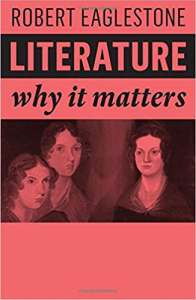


Literature: Why It Matters by Robert Eaglestone
Polity 2019

I enjoy these small books about big topics, and the Why It Matters series from Polity Books is another good source of quick, distilled information. The literature topic is very complex, more than I'd imagined. I did like this volume, but, again, cannot easily tell you what it's about. I'll let the publisher explain it:
"Facts alone are wanted in life," exclaims Mr Gradgrind at the beginning of Dickens' Hard Times. Literature is not about facts alone, and – despite two and a half thousand years of arguments – no one can agree on what it is, or how to study it. But, argues Robert Eaglestone, it is precisely the open-ended nature of literature that makes it such a rewarding and useful subject.
Eaglestone shows that studying literature can change who you are, turning you from a "reader" into a "critic": someone attuned to the ways we make meaning in our world. Literature is a living conversation which provides endless opportunities to rethink and reinterpret our societies and ourselves. With examples ranging from Sappho to Skyrim, this book shows how literature offers freer and deeper ways of thinking and being.

The whole series is worth reading, and this one only has 12 books!


Season of Migration to the North by Tayeb Salih
Translated by Denys Johnson-Davies
Heinemann, 2008
Originally published in Arabic, 1966

I had high hope for this short novella. It's another of my finds in the clearance section at my local used bookstore. I had not heard of the author before, but the influential literary critic Edward W. Said proclaimed this novel to be "among the six finest novels to be written in modern Arabic literature". It also fit into my plan to read more translated literature.

One of the glowing reviews, in the The Observer (London), had this to say:
An "Arabian Nights" in reverse, enclosing a moral about international misconceptions and delusions. This is the story of a student who returns to his village after his obsession with the West had led him to London and the beds of women with similar obsessions about the mysterious East...Powerfully and poetically written and splendidly translated by Denys Johnson-Davies.
The first 2/3 of the book was very interesting, the prose lyrical and readable. The descriptions of the Sudanese men in London and the Londoners' impressions of the Sudanese men are well written, and perhaps especially enlightening in the current era of trying to understand racial bias. But then it veered off into violence and the grotesque. I did finish it, but overall I would say I did not like this book. I don't like violent, grotesque movies or TV shows either. Maybe if you can think of it all as allegory you would like it.

This is my entry in the Classic in Translation category for the 2020 Back to the Classics challenge. It's also part of my reading for the 2020 Mount TBR Challenge.


01 March 2020

Rivers of Consciousness

Room Temperature
Nicholson Baker
Grove Press, 1990
116 pages


Maybe Nicholson Baker has to be experienced rather than summarized. First of all, there is no plot in the traditional sense. The narrator, Michael Beal, muses on life for 20 minutes as he gives his infant daughter, affectionately referred to as Bug, her afternoon bottle. The style is stream-of-consciousness, but here it's on overdrive. The stream relates not just things floating at the top of Michael's mind, but rather every little thought or fragment that occurs in his internal monologue. We get tales of Michael growing up, going to music school and college, dating, and as a young husband and father, mostly in snippets that weave in an out of the reverie.


And what a reverie it is! Michael is very learned, making allusions to literature, science, art, music, history, and culture. The NY Review of Books said of Baker: 
You didn’t read Baker for plot turns or the careful delineation of character, or even for ideas. You read him for sentences and similes that would take your breath away, for pages of description more exciting than any James Bond thriller. 
https://www.nybooks.com/articles/2013/11/21/funny-serious-too/

Before this I read "The Mezzanine", his first book, which is a similar stream-of-consciousness story following an office worker on his lunch hour trip to buy shoelaces. Both of them are interesting and entertaining, especially if you admire the creative use of words. And it helps if you Google the various people and concepts that are new to you. They are also quite funny and quirky.

From various recent reviews, I understand that Baker's style has changed a lot in the 30 years since this early book was published. Now I want to check out more of his work to see where it has taken him.

This is part of my reading for the 2020 Mount TBR Challenge.

26 February 2020

Industrial Poverty

Mary Barton: A Tale of Manchester Life
Elizabeth Gaskell
Penguin, 1986 (first published 1848)
487 pages


"Mary Barton" tells the story of four Manchester families, but ultimately it's the story of the industrial poverty in Manchester, England, during a period that later came to be known as the "hungry forties". During the 1840s bad harvests, economic depression, and other issues led to severe poverty and hunger for the working class in Manchester, the heart of England's Industrial Revolution.

Mrs. Gaskell gives a very realistic portrayal of the impoverished workers and their families as they struggled to survive in squalid slums: very little clothing, shacks that were damp and drafty, little firewood for heat or candles for light, almost no food, children starving to death or freezing to death. Her scenes of everyday life are quite detailed and quite often grim. In this urban realism style she also shows us the prisons, courts & lawyers, the hostile relationship between workers and factory owners, and the nascent trade union movement.


The main plot follows the lives of two families of mill workers, John and Mary Barton and their daughter Mary; and their friends George and Jane Wilson, son Jem, and George's sister Alice. Another family is also important, young Mary's friend Margaret Jennings and Margaret's grandfather, Job Legh. All three families are beset by poverty, disease, and death during the story. A fourth family is less talked about but pivotal to the plot: the wealthy mill owner John Carson, Mrs. Carson, and their son Harry.

In the first half of the book we see the extreme conditions in Manchester's poor neighborhoods and learn about the grievances of the workers against the mill owners. It's mostly the story of John as he becomes more and more bitter about his life and joins the trade union. A murder happens and the second half of the book is the tale of young Mary's efforts to prove the man she loves is innocent of the crime. The first half is taken up with lots of atmosphere and the plight of the poor. Then, having established the background, the rest is more of a murder mystery. There is a happy ending for some of the characters, although it involves a rather contrived plot device, pretty much a deus ex machina.

Like many other Victorian novels, it is long with a complicated plot. Is has lots of those long, involved sentences that were in vogue then, the type that require re-reading to understand. But it was not difficult to read and I enjoyed the story. Mrs. Gaskell was very gifted in the way she wrote about the characters' feelings. Sometimes I had to take a break because I was so caught up in the story and was anxious about what would happen next.

Luckily this large book does not have a cast of thousands like some. I found it easy to keep track of who was who, unlike in Anthony Trollope's "Can You Forgive Her" when I had to draw family trees to follow the many characters. Because the British historical background is pertinent to understanding the story, I was happy to have an annotated edition that explained the cultural references which are opaque to us today.

Elizabeth Gaskell is a writer that is perhaps overlooked by today's readers of classic novels, and I think that is a mistake. This was the first of her six novels and was very well-written. She also wrote a biography of her friend Charlotte Bronte, which The Guardian named one of the 100 best nonfiction books of all time in 2017.


The is my entry in the 19th Century Classic category for the 2020 Back to the Classics Challenge and it's also part of my reading for the 2020 Mount TBR Challenge.


10 February 2020

Black or White in 1920s America

Quicksand / Passing
Nella Larsen
Rutgers University Press, 1995  (first published 1928, 1929)
246 pages


I discover some of my very best reads from book blogger reviews, and this book is no exception. Of course I don't know who it was, but here's a general "Thank you!" to all who are avid readers and bloggers.

This book contains two novellas written by a woman who was an acclaimed novelist of the Harlem Renaissance of the 1920s. Appropriately (and accidentally) February is Black History Month.


In "Quicksand" the main character, Helga Crane, shares some biographical details with the author. Both are half Black and half Danish. Both grow up in Chicago with a White stepfather who doesn't like that they are half Black. Both lived in the deep South, Harlem, and Denmark. Larsen's life story is a bit sketchy, but it does not follow Helga's exactly. Their shared experiences, though, do mean that Larsen could easily draw her characters and their milieu realistically.

During the story, Helga moves from somewhere outside Atlanta to Chicago, then Harlem in New York, Denmark, and back to Harlem. She never feels she belongs anywhere, with Blacks or Whites. She seems rather aloof and has no close friends. She also doesn't know what she wants; a few years after she gains an objective and thinks she is finally happy, she become dissatisfied and restless again.

The plot thus far seems believable to me, but it then takes a dramatic turn which I found totally unconvincing. Helga has a sudden, intense religious conversion during a gathering she happens upon at a low point in her life. She makes another impulsive move, ending up in rural Alabama, impoverished, ill, unhappy again, and basically "barefoot and pregnant".

I can accept that she might have a deep religious conversion, but not the degradation she subjected herself to afterwards. She had always been so fastidious, cool and analytical, ambitious, a lover of nice things, semi-fluent in Dutch. Maybe I don't understand such a conversion because I've never experienced one.

The second story, "Passing" is much shorter but very interesting. Two Black women who were childhood friends meet accidentally in Chicago. One leads a conventional life, married to a Black doctor with two children. The other one is married with one child but is passing for White; even her White husband doesn't know the truth. And he is a rabid racist.


I enjoyed both novellas with their detailed descriptions of people and places, evoking life in the 1920s in America and Denmark. Both stories highlight the experiences of Black women in Black society and in White. The depiction of the characters' inner lives is captivating and vivid. On the back cover the publisher writes:

As noted in the editor's comprehensive introduction, Larsen takes the theme of psychic dualism, so popular in Harlem Renaissance fiction, to a higher and more complex level, displaying a sophisticated understanding and penetrating analysis of black female psychology.

I highly recommend reading both of these novellas, which are often published together in one volume.

The is my entry in the Classic by a Person of Color category for the 2020 Back to the Classics challenge and it's also part of my reading for the 2020 Mount TBR Challenge.


FURTHER READING

Nella Larsen
Black History Now: Black History Biographies from the Black Heritage Commemorative Society
http://blackhistorynow.com/nella-larsen/

Passing, in Moments: The uneasy existence of being black and passing for white.
Words by Mat Johnson
Topic Magazine
https://www.topic.com/passing-in-moments

15 December 2019

Joining Mount TBR 2020

I think I have found the perfect book challenge for me: climbing Mount TBR!! I moved last year and prepared for it by sorting through all my books, eliminating many boxes of them. I sold quite a few and donated others to the Friends of the Library here in Cincinnati. I also catalogued the keepers in the online library catalogue Libib, which I reviewed here: https://booktapestry.blogspot.com/2018/07/libib-built-for-personal-collections.html


So now I know the frightening reality of my book collection. Let's just say that they cover 66 linear feet of bookshelves. Time to get reading my own books and stop getting new ones out of the library, no matter how fascinating they may sound in a review. Please!

Enter Mount TBR 2020. I am joining at the Mount Ararat level, pledging read 48 books from my To Be Read piles during 2020. I might go for more, but let's be sensible for right now; I can upgrade to a newer mountain later if I need to. I am just going to wing it and list them as I go along, because I often choose books based on other challenges I join.

This should be fun and accomplishing this goal will make me very happy next New Year's Day!