Showing posts with label SRSR. Show all posts

01 January 2019

Short Reads Short Reviews #4: Becoming French

Every Frenchman Has One
Olivia de Havilland
Penguin Random House, 2016
143 pages


This is an amusing little book of short pieces by Olivia de Havilland, the retired actress who won 2 Oscars and many other awards in her long career. On the eve of her 100th birthday, the 1961 book was reissued with a short interview with Miss de Havilland as she turned 100.
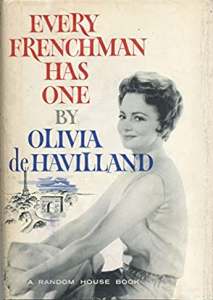

She fell in love with a Frenchman and moved to Paris in 1953, where she has remained up to this day. In this book she humorously recounts many incidents that happened to her as she learned to be French. As the publisher's blurb puts it, "her skirmishes with French customs, French maids, French salesladies, French holidays, French law, French doctors, and above all, the French language are here set forth in a delightful and amusing memoir of her early years in the City of Light."

Her style is light and funny, as though she were an old friend telling you of her adventures with as much wit and exaggeration as she could get away with.
Of course the thing that staggers you when you first come to France is the fact that all the French speak French—even the children. Many Americans and Britishers who visit the country never quite adjust to this, and the idea persists that the natives speak the language just to show off or be difficult.
On a long, cold, grey winter day, this would be a perfect pick-me-up accompanied by a cup of something hot, especially if you, like me, have a soft spot in your heart for Paris.

P. S. The secret word is "liver".


05 August 2018

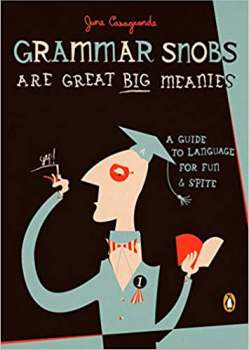
Short Reads Short Reviews #3: Grammar Snobs

Grammar Snobs are Great Big Meanies: A Guide to Language for Fun and Spite
June Casagrande
Penguin, 2006
199 pages


I plan on doing some creative writing this fall, so I checked out a small book on grammar in order to brush up on the subject. The book is a compilation of Casagrande's columns in the Los Angeles Times newspaper, with 62 short chapters. Her style is very casual and easy to read. It's also unexpectedly snide, sarcastic, and funny.


http://www.amazon.com/exec/obidos/ASIN/0143036831/ref=nosim/webxina/

Although you might not be able to define the word "grammar", you will probably remember hearing about most of the topics when you were in school: punctuation, clauses, dangling participles, possessives, etc.  Happily, I remembered most of it fairly accurately. I think that anyone who reads a lot of literature will have the same reaction, but it's always good to revisit the topic now and then.

The area that I found the most enlightening was the subjunctive mood. I vaguely recall the topic in high school Latin class and now it pops up as I try to teach myself Spanish. So what is it? Basically the subjunctive form of a verb is used when making a statement that is hypothetical or contrary to fact. "I wish I were better at Spanish." "I wish I had taken an umbrella today." As it turns out, I did know how to use it, but I didn't know what it was called!

The one caveat I have about this book is that you should read it in small doses. In her effort to make the subject entertaining instead of intimidating, the author has gone overboard with the snide and sarcastic comments. She gets downright nasty about many well-known authors she considers to be grammar snobs. Plus there are lots of silly asides about her life that I found uninteresting. Overall, though, it's a breezy, easy way to check your grammar savvy.


23 July 2018

Short Reads Short Reviews #2: The Bookshop

The Bookshop
Penelope Fitzgerald
Houghton Mifflin, 1997 (originally published 1978)
117 pages


This novella may be short, but it paints a clear picture of the main character, Florence Green, and the little seaside town of Hardborough, England, where she lives. A widow, Florence decides to open a bookshop in that depressing backwater, which in 1959 has no fish and chips shop, no launderette, and films are shown only once a fortnight. The place seems full of dour people living dour lives. Early in the book, Mr. Raven the marshman* talks to her about the people of Hardborough, saying "They've lost the wish for anything of a rarity."


http://www.amazon.com/exec/obidos/ASIN/0544484096/ref=nosim/webxina/

Excellent vignettes show life in a small town, as applicable to small towns everywhere as to those in England. Everyone knows what everyone else is doing at all times. Gossip is rampant, and often malicious. And the moneyed class always gets their way.

I thoroughly enjoyed this little book and its quirky characters, who acted in unexpected ways and said odd things. It has a gentle self-deprecating humor running through it, a gentleness and humor shared by Florence herself. It was shortlisted for the Booker Prize in 1978, edged out by Iris Murdoch's "The Sea, The Sea".


* marshman: Employed by landowners to tend marshland and the animals grazing there


19 July 2018

Short Reads Short Reviews #1: The First Five Pages

The First Five Pages
Noah Lukeman
Simon & Schuster, 2000
208 pages (197 pages plus an index)


For my first Short Reads Short Reviews book, I chose a nonfiction title about writing and publishing a novel. Noah Lukeman is a literary agent who has read many, many manuscripts and has decided to help authors make their books more publishable.

http://www.amazon.com/exec/obidos/ASIN/068485743X/ref=nosim/webxina/
 

It is not about how to write a novel but about the pitfalls an author can fall into because of carelessness, laziness, or ignorance, or maybe hubris. His introduction states:

There are no rules to assure great writing, but there are ways to avoid bad writing. This, simply, is the focus of this book: to learn how to identify and avoid bad writing.

There are three sections containing a total of 19 chapters, each discussing one type of bad writing -- giving examples, solutions, and often clever exercises to perform on your own text. Preliminary Problems has five chapters on very basic mistakes that will likely get your manuscript rejected out of hand by most agents or editors. Grimy pages, improper formatting, and poor use of adverbs, adjectives, similes, and metaphors are marks of an amateur. The five chapters on Dialogue discuss topics such as melodramatic or humdrum dialogue between characters. The largest section, The Bigger Picture, talks about everything else, from viewpoint to showing versus telling to tone, focus and setting.

I found this a very valuable read even before I begin to write during NaNoWriMo (National Novel Writing Month) this November. And after November ends I certainly need to reread it as I begin to edit my manuscript. I liked its practicality, and the way it showed me an editor's view of a new manuscript from an unknown writer. If you want to write either fiction or nonfiction, maybe even poetry, you need to read this!


FURTHER READING

Mr. Lukeman has written two other books on getting published, which he has released bundled into one free edition, available from his personal website in several formats including PDF, Kindle, and iTunes. Just scroll to the bottom of the web page.

"How to Write a Great Query Letter: Insider Tips and Techniques for Success"
"How to Land (and Keep) a Literary Agent"
http://www.lukeman.com/landaliteraryagent/index.htm