11 May 2018

Herzoslovakian Feud Spills Blood

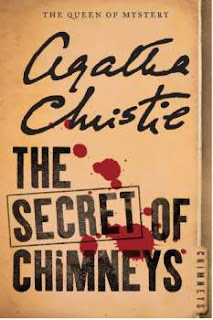
The Secret of Chimneys
Agatha Christie
Bantam Books, 1987 (first published 1925)
232 pages

I enjoyed Christie's "The Seven Dials Mystery" [my review is here] that I chanced upon at the library recently, and then realized it was listed as #2 in the Superintendent Battle series at Amazon.com. So back I went to retrieve book #1, "The Secret of Chimneys", and it's another nice mystery tale with many of the same lead characters.

The story takes place at Chimneys, the English country house setting of both books, but this time it's a weekend of political intrigue, with a house full of diplomats, aristocrats, and royalty, plus a few detective types, both professional and amateur. The plot involves the fictional Balkan country of Herzoslovakia, with its history of revolution, the murders of the King and Queen and of several recent Presidents. Prince Michael, the next in line, is maneuvering to get back the throne, financed by selling the rights to the newly discovered Herzoslovakian oil supplies. Several bodies are found in mysterious circumstances, a memoir by the late Herzoslovakian Prime Minister is threatening to start a European-wide war, a long-lost jewel is sought by a notorious jewel thief, and a bundle of blackmail letters are not what they seem. The requisite number of plot twists ensue and several characters are not who you were lead to believe they are. Quite satisfying and I never guessed the solution.

 http://www.amazon.com/exec/obidos/ASIN/0312979746/ref=nosim/webxina/
http://www.amazon.com/exec/obidos/ASIN/0312979746/ref=nosim/webxina/

A lot seemed to happen in this book. People weren't just sitting around flirting or discussing the latest racing results to while away a weekend in the country. Important developments kept happening at a fast pace. There are quite a few characters, but most of them are talked about frequently and take part in the action, so it's not too hard to keep them straight, although now and then I did lose track of who Baron Lolopretjzyl was - and don't ask me how to pronounce that name!

Well, it's three down, two to go in the Inspector Battle 5-book series, although I'm not quite sure it really is a series. This 1987 copy of "The Secret of Chimneys" makes no mention of one, nor does the official Agatha Christie web site. Maybe the idea of calling them a series came from a publisher more recently. Both this book and "The Seven Dials Mystery" do feature a group of the same characters, so they are related in a way. Book #3 "Cards on the Table" is usually portrayed as a Hercule Poirot novel. It has four sleuths, including Poirot and Battle, trying to solve their dinner host's murder. I haven't yet read the other two, but for Book #4, "Murder Is Easy", Wikipedia says "Christie's recurring character, Superintendent Battle, has a cameo appearance at the end, but plays no part in either the solution of the mystery or the apprehension of the criminal." Battle does seem to be back in charge for Book #5, "Towards Zero".

Series or not, "The Secret of Chimneys" is fast-paced and entertaining!


05 May 2018

A Geeky Family's Drama

The Last Equation of Isaac Severy: A Novel in Clues
Nova Jacobs
Touchstone, 2018
352 pages


Isaac Severy, venerable patriarch of the brainy and eccentric Severy clan, has just died and the bereft family members are struggling to cope. His granddaughter Hazel receives a posthumous note from Isaac, who was a famous mathematician, setting her off on a search for an equation. Given only a few mysterious clues, she is asked to find the equation and deliver it to Isaac's friend for safe keeping. During the search she discovers that there are lots of secrets spread throughout the family.


http://www.amazon.com/exec/obidos/ASIN/1501175122/ref=nosim/webxina/
 http://www.amazon.com/exec/obidos/ASIN/1501175122/ref=nosim/webxina/

This is an inventive mystery with surprising plot twists, and I liked it very much. However I do feel it is a bit too ambitious in some respects. There are so many characters that I had to stop and create a family tree on paper to keep all the relatives straight. Many of them appear multiple times and take up space, but are not part of the main plot. One or two sub-plots could be dispensed with, too. I just think it needed some editing, to give the main characters some breathing space and develop them more. I wanted to know Hazel better, as she seemed quite interesting.

This is an impressive debut novel and I really did enjoy it, so I feel bad criticizing it. It just took a lot for me to work through it. I'll be watching for Jacobs' next book, to see what sort of interesting new story she constructs!


Jan Morris' Conundrum

Conundrum: From James to Jan - An Extraordinary Personal Narrative of Transsexualism
Jan Morris
Harcourt Brace Jovanovich, 1974
174 pages


I love the travel writing of Jan Morris, and had long thought about reading this memoir. Since I am currently planning some travels of my own, I came across her name again and checked "Conundrum" out of the library.

http://www.amazon.com/exec/obidos/ASIN/1590171896/ref=nosim/webxina/
 http://www.amazon.com/exec/obidos/ASIN/1590171896/ref=nosim/webxina/

Afterwards I felt like I had met her in a cozy tearoom and we had had a nice long chat over some delicious tea and scones. In this most personal of memoirs she tries to explain what may well be inexplicable, even to her, namely feelings about gender and sex. Most of the book is about her life before the sex reassignment surgery: her early life at school, in the British Army during WWII, and her years spent on the road as a travel author. She tries to convey what she felt as James Morris, what she felt during the 10-year transition from male to female, and what she is feeling now as Jan.

There is nothing lurid, no graphic details of the surgery. What would you expect of such a nice British lady? Instead there are ponderings about the topics of relationships, belonging, family, and gender and sex. She has a theory/idea of a scale and a pointer correlating gender and sex, though I'm not sure I understood that completely.

© David Hurn
Reading "Conundrum" now seemed very timely, despite the 44 years since it's publication. Issues about LGBT rights have been in the news from all over the world in recent years. Reading about transsexualism from the inside is a thought-provoking experience.


Further Reading


"Writer Jan Morris on reporting from Everest and changing sex"
Henry Mance, The Financial Times
https://www.ft.com/content/fd6e31da-2cf3-11e8-9b4b-bc4b9f08f381

"Love story: Jan Morris - Divorce, the death of a child and a sex change... but still together"
Andy McSmith, The Independent
https://www.independent.co.uk/news/uk/this-britain/love-story-jan-morris-divorce-the-death-of-a-child-and-a-sex-change-but-still-together-839602.html


03 May 2018

Alberto Manguel and Jorge Luis Borges

With Borges
Alberto Manguel
Telegram Books, 2006
77 pages

I first discovered Alberto Manguel's lovely writing when I read "A History of Reading", to be reviewed shortly. How I stumbled upon that book is a mystery, an Internet Mystery. One reads blogs, follows links to more blogs and review sites, and eventually some book's description grabs your full attention and you order it online. Well, that's how my reading life goes at any rate. Then having enjoyed the first Manguel book so much, I looked for more. The title "With Borges" caught my eye because I loved reading Jorge Luis Borges' works when I was in college, so I ordered that one, too.


http://www.amazon.com/exec/obidos/ASIN/1846590051/ref=nosim/webxina/

Manguel was 16 and working in a bookshop in Buenos Aires when he first met the famous Argentine writer. The older man was blind by then, and he asked Manguel to read to him at his apartment. Manguel did so three or four times a week over a four-year period. And for the next 16 years, until Borges death in 1986, they were friends. While it is a very short book, it contains wonderful, insightful stories about Borges, his author-friends, and his thoughts on writing and writers.

A must read if you love Literature, Borges, or Manguel.

02 May 2018

Intro to Italian Lit

Italian Literature: A Very Short Introduction
Peter Hainsworth and David Robey
Oxford University Press, 2012
128 pages

I came across this slim volume while looking for books the old-fashioned way at the library: by perusing the shelves. Usually I discover an interesting book in one of the book-review blogs I frequent; then I jump over to my library's web site, put it on hold, and pick it up down the street at the local branch library. It's very efficient, but the thrill of serendipitous discovery is absent.

This time I was wandering in a newly re-organized library and found this little gem. With my background in microbiology and computer science, I can feel intimidated by literary references and literary criticism, although I am a fervid reader. So I was quite tickled to find such a succinct introduction. I haven't read much Italian literature, but I am currently working on Umberto Eco's "Baudolino" and have just ordered a copy of "The Decameron" by Giovanni Boccaccio.

http://www.amazon.com/exec/obidos/ASIN/0199231796/ref=nosim/webxina/

Although there are only 128 pages, the type is rather small, as are all the margins, so the book punches above its weight, as they say. The publisher's summary is as follows:
In this Very Short Introduction, Peter Hainsworth and David Robey examine Italian literature from the Middle Ages to the present day, looking at themes and issues which have recurred throughout its history. The authors illuminate such topics as regional identities, political disunity, and the role of the national language and they cover a wide range of authors and works, including Dante, Petrarch, Manzoni, Montale, and Calvino. They explore some of the distinctive traditions of the literature, such as its concern with politics and its secular orientation in spite of the Catholic beliefs and practices of the Italian people, and they conclude by looking at recent developments in Italian literature, such as the influence of women's writing in Italian.

After the main text there is a section of Further Reading with books listed by various topics and a list of all the writers cited with their dates and types of writing. I'm far from being an expert now, but I have a feel for what's available in Italian literature. Once I've read a goodly number of Italian novels, I would like to re-read this book for more perspective on the topic.


Very Short Introductions

Oxford University Press has a huge series of these small volumes called Very Short Introductions, with over 300 books on every imaginable topic. This is how they describe the series:
Oxford's Very Short Introductions offers concise and original introductions to a wide range of subjects--from Islam to Sociology, Politics to Classics, and Literary Theory to History. Not simply a textbook of definitions, each volume provides trenchant and provocative--yet always balanced and complete--discussions of the central issues in a given topic. Every Very Short Introduction gives a readable evolution of the subject in question, demonstrating how it has developed and influenced society.

I plan on reading some of their introductions to national literatures, literary genres, and individual authors.