15 October 2020

Book Beginning: The Peppermint Tea Chronicles by Alexander McCall Smith


Book Beginnings is a weekly meme hosted by Rose City Reader. We share the first sentence (or so) of the book we are reading, along with our initial thoughts about the sentence, impressions of the book, or anything else the opener inspires.

Domenica Macdonald, anthropologist, resident of Scotland Street, and wife of Angus Lordie, portrait painter and long-standing member of the Scottish Arts Club, sat in the kitchen of her flat in Scotland Street.


Huzzah, a comfort read for troubled times. This is book 13 in the 44 Scotland Street series by Alexander McCall Smith, published late last year. I do so love these books, as well as most of his other works. They won't win him the Nobel Prize or even the Booker Prize, but they are extremely enjoyable and full of stories about regular, normal, everyday humans, replete with all their foibles.

Sometimes the books can seem a bit disjointed, as each short chapter tends to repeat or summarize some of the scenes of last one. This is the result of their original format: they have been serialized daily in "The Scotsman" newspaper since 2004.

I can't wait to see what Bertie, Cyril, Mathew and Elspeth, Pat, Big Lou, and the other characters are up to now!


09 October 2020

Book Beginning: Hyperbole and a Half by Allie Brosh


Book Beginnings is a weekly meme hosted by Rose City Reader. We share the first sentence (or so) of the book we are reading, along with our initial thoughts about the sentence, impressions of the book, or anything else the opener inspires.
 

When I was ten years old, I wrote a letter to my future self and buried it in my backyard. Seventeen years later, I remembered that I was supposed to remember to dig it up two years earlier. 

I looked forward to getting a nostalgic glimpse into my childhood - perhaps I would marvel at my own innocence or see the first glimmer of my current aspirations. As it turns out, it just made me feel real weird about myself.


This is a graphic/comic memoir that came out of Allie Brosh's blog of the same name. The subtitle is "unfortunate situations, flawed coping mechanisms, mayhem, and other things that happened". I've read a lot of it already and it is strangely compelling and repelling at the same time. 


18 September 2020

Book Beginning: Nine Lives: The Folklore of Cats by Katharine Briggs

Book Beginnings is a weekly meme hosted by Rose City Reader. We share the first sentence (or so) of the book we are reading, along with our initial thoughts about the sentence, impressions of the book, or anything else the opener inspires.
 

The great day for the cat must be placed some two thousand years ago in Ancient Egypt, when cats enjoyed a position of special privilege, and had long held it.


I have loved cats for most of my life, and lived with them for many years. I don't have a feline companion at the moment, but this summer I started volunteering at Ohio Alley Cat Rescue, which is just down the street from me. We usually have 40-50 kittens and cats in residence on any day, so I can get my kitty cuddles frequently! Thus I was intrigued by the title of this book and bought it sight unseen from Powells.com, my favorite bookstore.

11 September 2020

Book Beginning: The Art of Travel by Alain de Botton


Book Beginnings is a weekly meme hosted by Rose City Reader. We share the first sentence (or so) of the book we are reading, along with our initial thoughts about the sentence, impressions of the book, or anything else the opener inspires.

It was hard to say when exactly winter arrived. The decline was gradual, like that of a person into old age, inconspicuous from day to day until the season became an established, relentless reality.


I've seen this book mentioned many times by travellers and travel writers. Since I'm trying to get motivated about travel planning - when travel is an unknown quantity at present - I thought I would listen to some travel philosophy.


04 September 2020

Book Beginning: Ten Years a Nomad by Matthew Kepnes


Book Beginnings is a weekly meme hosted by Rose City Reader. We share the first sentence (or so) of the book we are reading, along with our initial thoughts about the sentence, impressions of the book, or anything else the opener inspires.


    I AM A NOMAD

        For a decade I have lived a long, peripatetic life on the road.

        Three thousand nights.

        In more than ninety countries. In a thousand different cities. In hundreds of hostels. With countless people. For half a million miles on airplanes, and half a million more (I've added it up) on trains and buses and tuk-tuks and cars and bicycles.

        That was my home.


There is also an opening quote in the Introduction which I like a lot:

I haven't been everywhere, but it's on my list.
        -Susan Sontag


I first found Matt and his fellow digital nomads back when I was contemplating making a change in my own life. I've been reading his blog/website, Nomadic Matt, for several years and I read his first book, "How to Travel the World on $50 a Day". Non-stop travelling sounded so exciting.

My life did change abruptly when I was diagnosed with breast cancer in 2016 and I never did become a nomad. After my treatments I retired from my online crafts shop, SkyBluePink, and was beginning to travel frequently when the novel coronavirus struck. Now I'm dreaming of travelling again someday and looking for inspiration to keep my spirits up. So I think I will enjoy Matt's newest memoir of being on the road for 10 years.


20 August 2020

Book Beginning: The Library of Lost and Found by Phaedra Patrick


Book Beginnings is a weekly meme hosted by Rose City Reader. We share the first sentence (or so) of the book we are reading, along with our initial thoughts about the sentence, impressions of the book, or anything else the opener inspires.
 
As always, Martha Storm was primed for action. Chin jutted, teeth gritted, and a firm grip on the handle of her trusty shopping trolley.

 I saw this book recommended somewhere as a nice, sweet story and that sounded about where my head is these days. My concentration has gotten better but I don't think I can read a Dickens' novel or anything Classic and heavy duty. Still, I able to pay attention to audiobooks while I knit my charity hats, so that's an improvement in my Pandemic State of Mind. I look forward to finding out about the always-ready-for-action Martha!


13 August 2020

Book Beginning: Three Men in a Boat by Jerome K. Jerome


Book Beginnings is a weekly meme hosted by Rose City Reader. We share the first sentence (or so) of the book we are reading, along with our initial thoughts about the sentence, impressions of the book, or anything else the opener inspires.

There were four of us—George, and William Samuel Harris, and myself, and Montmorency.  We were sitting in my room, smoking, and talking about how bad we were—bad from a medical point of view I mean, of course.


A comedy that seems to be very popular with the Classics Club set, and who doesn't need a good laugh about now? The subtitle reads: "(to say nothing of the dog)". Which might explain the opening phrase "There were four of us". We shall see!


03 August 2020

Classics Club Spin #24


It's Classics Club Spin time again! Each Clubber has a personal list of 50-100 classic books that we have chosen to be our challenge list. For the Spin we pick 20 of those titles and put them into a numbered list. On August 9th the Club moderators will draw a number from 1 to 20 and we have to read that book on our list by the end of September and report back to the Club.

I failed completely for Spin #23 - I just could not read anything in April and May. But I'm hoping to be in a reading mood now, so here's a list of books that I think I have on my shelves or can get for my Kindle. First publication date is in parentheses.

  1. At Swim-two-birds, Flann O'Brien (1939)
  2. Billy Budd and other Tales, Herman Melville (~1891)
  3. Candide, Voltaire (1759)
  4. The Dubliners, James Joyce (1914)
  5. Emma, Jane Austen (1815)
  6. Enemies, A Love Story, Isaac Bashevis Singer (1966)
  7. Eugénie Grandet, Honoré de Balzac (1833)
  8. Huckleberry Finn, Mark Twain (1884)
  9. Jane Eyre, Charlotte Brontë (1847)
  10. The Man in the Brown Suit, Agatha Christie (1924)
  11. Oroonoko, The Rover and Other Works, Aphra Behn (<1689)
  12. The Autobiography of Alice B Toklas, Gertrude Stein (1933)
  13. The Rainbow, D. H. Lawrence (1915)
  14. The Reef, Edith Wharton (1912)
  15. A Tale of Two Cities, Charles Dickens (1859)
  16. Things Fall Apart, Chinua Achebe (1958)
  17. This Side of Paradise, F. Scott Fitzgerald (1920)
  18. Three Men in a Boat, Jerome K. Jerome (1889)
  19. The Vicar of Bullhampton, Anthony Trollope (1870)
  20. Wives and Daughters, Elizabeth Gaskell (1864)


I'm looking forward to reading them all eventually, but I think I'd like to tackle Gertrude Stein's "The Autobiography of Alice B Toklas". Go #12!


UPDATE: The spin is #18, so I have a date with "Three Men in a Boat" by Jerome K. Jerome. Everyone tells me it's great fun, so I'm happy. Cheerful books are easier for me to concentrate on during these trying days.


26 June 2020

Book Beginning: Sandwich: A Global History by Bee Wilson


Book Beginnings is a weekly meme hosted by Rose City Reader. We share the first sentence (or so) of the book we are reading, along with our initial thoughts about the sentence, impressions of the book, or anything else the opener inspires.
Portable, quick, satisfying, cheap and requiring neither plate nor cutlery, the sandwich is the most universal of all fast food, the archetypal hand-held snack.

Lately I have unearthed quite a few series of small, non-fiction books. "Sandwich" is from one called "Edible" with single-word titles such as: Milk, Pancake, Soup, Spices, Whiskey, and Chocolate. The publisher says:
Edible is a revolutionary new series of books dedicated to food and drink that explores the rich history of cuisine. Each book reveals the global history and culture of one type of food or beverage.

I think this will be perfect for light summer reading, although it might be hunger inducing!

17 June 2020

Some Current Reads


It's a few days late for it, but here's my entry for June's Quick Lit, a monthly meme on the Modern Mrs. Darcy blog. The creator is Anne Bogel, who explains that Quick Lit is where "we share short and sweet reviews of what we’ve been reading lately on the 15th of the month".


Translation: A Very Short Introduction by Matthew Reynolds

This is another book in Oxford University Press's A Very Short Introduction series, now 689 books strong. From Abolitionism to Zionism, from Lincoln to Rousseau, from Advertising to Sleep, and everything in between is discussed in a very accessible way in about 125 pages each.

So far I've read "Italian Literature", "Languages", and now "Translation". I find this series perfect for dipping a toe into a subject without digesting an entire 500-page tome on the topic. Each book has sections on references and further reading, in case I want to pursue that topic further.

I have been reading more literature in translation recently, and wanted to know something about the processes and issues involved. I find it hard to summarize this type of book, so I'm giving you the publisher's blurb about it:
In this Very Short Introduction, Matthew Reynolds gives an authoritative and thought-provoking account of the field, from ancient Akkadian to World English, from St Jerome to Google Translate. He shows how translation determines meaning, how it matters in commerce, empire, conflict and resistance, and why it is fundamental to literature and the arts.
Reading this slim volume helped me to better appreciate the translated novels I've been reading.


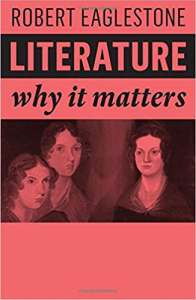
Literature: Why It Matters by Robert Eaglestone
Polity 2019

I enjoy these small books about big topics, and the Why It Matters series from Polity Books is another good source of quick, distilled information. The literature topic is very complex, more than I'd imagined. I did like this volume, but, again, cannot easily tell you what it's about. I'll let the publisher explain it:
"Facts alone are wanted in life," exclaims Mr Gradgrind at the beginning of Dickens' Hard Times. Literature is not about facts alone, and – despite two and a half thousand years of arguments – no one can agree on what it is, or how to study it. But, argues Robert Eaglestone, it is precisely the open-ended nature of literature that makes it such a rewarding and useful subject.
Eaglestone shows that studying literature can change who you are, turning you from a "reader" into a "critic": someone attuned to the ways we make meaning in our world. Literature is a living conversation which provides endless opportunities to rethink and reinterpret our societies and ourselves. With examples ranging from Sappho to Skyrim, this book shows how literature offers freer and deeper ways of thinking and being.

The whole series is worth reading, and this one only has 12 books!


Season of Migration to the North by Tayeb Salih
Translated by Denys Johnson-Davies
Heinemann, 2008
Originally published in Arabic, 1966

I had high hope for this short novella. It's another of my finds in the clearance section at my local used bookstore. I had not heard of the author before, but the influential literary critic Edward W. Said proclaimed this novel to be "among the six finest novels to be written in modern Arabic literature". It also fit into my plan to read more translated literature.

One of the glowing reviews, in the The Observer (London), had this to say:
An "Arabian Nights" in reverse, enclosing a moral about international misconceptions and delusions. This is the story of a student who returns to his village after his obsession with the West had led him to London and the beds of women with similar obsessions about the mysterious East...Powerfully and poetically written and splendidly translated by Denys Johnson-Davies.
The first 2/3 of the book was very interesting, the prose lyrical and readable. The descriptions of the Sudanese men in London and the Londoners' impressions of the Sudanese men are well written, and perhaps especially enlightening in the current era of trying to understand racial bias. But then it veered off into violence and the grotesque. I did finish it, but overall I would say I did not like this book. I don't like violent, grotesque movies or TV shows either. Maybe if you can think of it all as allegory you would like it.

This is my entry in the Classic in Translation category for the 2020 Back to the Classics challenge. It's also part of my reading for the 2020 Mount TBR Challenge.


08 May 2020

Book Beginning: Enemies, A Love Story by Isaac Bashevis Singer

Book Beginnings is a weekly meme hosted by Rose City Reader. We share the first sentence (or so) of the book we are reading, along with our initial thoughts about the sentence, impressions of the book, or anything else the opener inspires.

Herman Broder turned over and opened one eye. In his dreamy state, he wondered whether he was in America, in Tzivkev, or in a German camp.


Isaac Bashevis Singer always wrote in Yiddish and won the Nobel Prize in Literature in 1978. That's all I really know about him. I was a bit skittish about reading his work, fearing it would be about the Holocaust and too dark. But this is described as humorous, so I'm hoping for the best. It's my #6 for the Classics Club Spin #23.


07 May 2020

Common Sense about Language

Talk on the Wild Side: Why Language Can't be Tamed
Lane Greene
PublicAffairs, 2018
232 pages


For all you word people, this is a fantastic book! I loved it, plain and simple. Greene covers various topics, each showing, in a different way, why language can't be tamed, why it can't be put in a neat little perfectly logical box, with Rules. The range of topics can be deduced from the front blurb:

Samuel Johnson one said that "to enchain syllables, and to lash the wind, are equally the undertakings of pride." Nevertheless, many have tried: from sticklers for supposedly correct grammar to inventors of supposedly perfect languages; from software engineers working on machine translation to governments that see language management as politics by another means. But when you enter the lair of a wild beast, you may be lucky to escape with your wits intact. Join Lane Greene on a journey of discovery into the deep strangeness of language.

I'd heard of something called The Great Vowel Shift, but never could get my mind around the scant explanations I saw. He has a terrific explanation of how English vowel sounds moved away from the sounds in the rest of Europe. He shows this process using some examples from recent English.


 Another favorite chapter talks about how words start sticking together and changing over time. Again, I'd read that this has happened in the past, but never understood the process. He shows how we write things like "ought to work", "got to sleep", "have to run", and "going to try". But when we speak "the TO gets glommed on to the previous word": "oughta work", "gotta sleep", "hafta run", and "gonna try". If we had only spoken language, the actual words might start to change. Wow!

In a chapter entitled "Whom in a biker bar", Greene covers a large set of related topics such as various English dialects, Normal English vs. Formal English, how children learn their native language, and rules vs. preferences in grammar. There's an awful lot of information packed into that chapter, but I think the important ideas can be summed up by this paragraph:

The tricky cases that need to be taught explicitly to children in school belong almost exclusively to Formal. Normal is, by definition, what comes naturally to a native speaker. But Formal English includes all of the grammatical bits and pieces like whom, word order like the man about whom I was talking, and nominative case after the copula like it was she. These form part of the literary language that is a critical part of English-speakers' cultural heritage. Students need to learn Formal. But they should learn it for what it is: a specific kind of language for certain important purposes, and not the One Right Way. p. 173

This book is enlightening, funny, and wise, and I learned a lot about how we humans try to communicate. He also tweets out interesting tidbits, so you might want to follow him on Twitter, too: @lanegreene .


02 May 2020

A Life of Co-incidences

Indiscretions Of Archie
P.G. Wodehouse
Andrews UK, 2004
Originally published 1920
189 pages


Archie is my first Wodehouse character who is not Jeeves or Bertie Wooster or one of their pals. And poor Archie really, really needs a calm mess-fixer-upper like Jeeves. To be formal, the titular character is Archibald Moffam (pronounced "Moom"), another inimitable Wodehousian name.

Unlike Bertie Wooster, Archie is not wealthy, and after many business failures in England has gone to America to seek a new start. He falls in love and quickly marries a sweet girl, whose father turns out to be one of the richest men in New York. But his new father-in-law despises Archie.

 All of which sets the scene for the stories in this book, which is sometimes described as a book of short stories rather than a novel. The stories are in sequential order and all involve the same characters, so I think it can be considered either one.

The subtitle really ought to be: A Life of Co-incidences, for Archie ricochets from one crazy co-incidence to another like a ball in a Pachinko machine. In the early chapters, everything seems stacked against Archie, but as I read on things began to break his way -- still in extremely co-incidental ways. It was a diverting and fun read for the #1920Club over at Stuck in a Book.

P. G. (Pelham Grenville) Wodehouse published at least 71 novels and 24 story collections, as well as plays, a poem, some non-fiction, and other miscellaneous books. So if you decide you like his style, you have plenty of good reading ahead of you!


30 April 2020

Book Beginning: Richard Walden's Wife by Eleanor Mercein Kelly

http://www.rosecityreader.com/

Book Beginnings is a weekly meme hosted by Rose City Reader. We share the first sentence (or so) of the book we are reading, along with our initial thoughts about the sentence, impressions of the book, or anything else the opener inspires.

For a long time after the great family hegira - indeed, at intervals for the rest of her life - Emmeline would wake shivering in the solid security of her bed, reliving portions of it.


It's not often that I have to look up a word in the very first sentence of a novel, but "hegira" was not a word I really knew. I had fuzzy thoughts that it was something religious and perhaps Middle Eastern. Wikipedia tells us: "The Hegira is the migration or journey of the Islamic prophet Muhammad and his followers from Mecca to Yathrib, later renamed by him Medina, in the year 622."

So now we know that Emmeline's family made some sort of long journey. Intriguing! But who is Richard Walden, who is his wife, and where does Emmeline fit in?


23 April 2020

Book Beginning: Indiscretions Of Archie by P.G. Wodehouse

Book Beginnings is a weekly meme hosted by Rose City Reader. We share the first sentence (or so) of the book we are reading, along with our initial thoughts about the sentence, impressions of the book, or anything else the opener inspires.

Sir? replied the desk-clerk alertly. All the employees of the Hotel Cosmopolis were alert. It was one of the things on which Mr. Daniel Brewster, the proprietor, insisted. And as he was always wandering about the lobby of the hotel keeping a personal eye on affairs, it was never safe to relax.


Since I love Wodehouse's Jeeves and Wooster series, - in print, on film, on audiobook - I'm taking a plunge into a different Wodehouse world. Should be many crazy antics ahead!


21 April 2020

World Book Day 2020

https://www.un.org/en/observances/book-and-copyright-day


Are you ready for World Book Day? It will be upon us this Thursday, 23 April 2020. This special day was officially proclaimed in 1995 by UNESCO, The United Nations Educational, Scientific and Cultural Organization, and is celebrated by over 100 countries on that day.

According to the UNESCO web page, the full name is World Book and Copyright Day, and many festivities are planned all around the world. In addition, a World Book Capital is named each year, and that city promotes literacy throughout the year until April 23rd of the next year. Kuala Lumpur, Malaysia, is the World Book Capital for 2020.

23 April is a symbolic date for world literature. It is on this date in 1616 that Cervantes, Shakespeare and Inca Garcilaso de la Vega all died. It is also the date of birth or death of other prominent authors, such as Maurice Druon, Halldór K. Laxness, Vladimir Nabokov, Josep Pla and Manuel Mejía Vallejo.
- UN web page

I'm all for promoting books, reading, and literacy; they have always been a big part of my life. What makes me especially happy is that Amazon.com is celebrating by offering 9 Kindle books for free! And remember that free Kindle reader apps are available for most devices!

The categories of the nine free ebooks are: Contemporary Fiction, Thriller, True Crime, Chinese Literature, Romantic Comedy, Biographical Fiction, Historical Fiction, Children's Book, and Memoir. The books have all been translated into English, and come from a wide variety of languages. In addition many are by authors who are prize winners or best sellers in their native countries. Such a good chance to peek into another culture.

But hurry, these books are only free until 11:59 PM [Pacific Daylight Time] on Friday night. The time remaining is shown at the top of the download page, so check it in your local time zone. Here's the page on Amazon.com to get your free ebooks:

https://www.amazon.com/article/read-the-world-2020


FURTHER READING

* UN: World Book and Copyright Day 23 April
https://www.un.org/en/observances/book-and-copyright-day

* UNESCO: World Book Day
https://en.unesco.org/commemorations/worldbookday

* World Book Day - a British site for their day, 7 March 2019
https://www.worldbookday.com/


19 April 2020

Classics Club Spin #23


It's Classics Club Spin time again! Each Clubber has a personal list of 50-100 classic books that we have chosen to be our challenge list. For the Spin we pick 20 of those titles and put them into a numbered list. On April 19th the Club moderators will draw a number from 1 to 20 and we have to read that book on our list by the end of May and report back to the Club.

I've missed the last few Spins, but I'm in a reading mood now, so here's a list of books that I think I have on my shelves or can get for my Kindle. First publication date is in parentheses.

  1. At Swim-two-birds, Flann O'Brien (1939)
  2. Billy Budd and other Tales, Herman Melville (~1891)
  3. Candide, Voltaire (1759)
  4. The Dubliners, James Joyce (1914)
  5. Emma, Jane Austen (1815)
  6. Enemies, A Love Story, Isaac Bashevis Singer (1966)
  7. Eugénie Grandet, Honoré de Balzac (1833)
  8. Huckleberry Finn, Mark Twain (1884)
  9. Jane Eyre, Charlotte Brontë (1847)
  10. The Man in the Brown Suit, Agatha Christie (1924)
  11. Oroonoko, The Rover and Other Works, Aphra Behn (<1689)
  12. The Autobiography of Alice B Toklas, Gertrude Stein (1933)
  13. The Rainbow, D. H. Lawrence (1915)
  14. The Reef, Edith Wharton (1912)
  15. A Tale of Two Cities, Charles Dickens (1859)
  16. Things Fall Apart, Chinua Achebe (1958)
  17. This Side of Paradise, F. Scott Fitzgerald (1920)
  18. Three Men in a Boat, Jerome K. Jerome (1889)
  19. The Vicar of Bullhampton, Anthony Trollope (1870)
  20. Wives and Daughters, Elizabeth Gaskell (1864)

I'm looking forward to reading them all eventually, but I think I'd like to tackle Gertrude Stein's "The Autobiography of Alice B Toklas". Go #12!


UPDATE: The spin is #6, so I'm reading "Enemies, A Love Story", by Isaac Bashevis Singer. I know only a little bit about Singer: he was awarded the Nobel Prize for Literature, and he always wrote and published in Yiddish. I'm looking forward to reading this novel!


17 April 2020

Book Beginning: This Side of Paradise by F. Scott Fitzgerald


Book Beginnings is a weekly meme hosted by Rose City Reader. We share the first sentence (or so) of the book we are reading, along with our initial thoughts about the sentence, impressions of the book, or anything else the opener inspires.

Amory Blaine inherited from his mother every trait, except the stray inexpressible few, that made him worth while. His father, an ineffectual, inarticulate man with a taste for Byron and a habit of drowsing over the Encyclopedia Britannica, grew wealthy at thirty through the death of two elder brothers, successful Chicago brokers, and in the first flush of feeling that the world was his, went to Bar Harbor and met Beatrice O’Hara. In consequence, Stephen Blaine handed down to posterity his height of just under six feet and his tendency to waver at crucial moments, these two abstractions appearing in his son Amory.


This book was the debut novel for F. Scott Fitzgerald and was first published in 1920. All I know about it is that it "examines the lives and morality of post–World War I youth", according to Wikipedia. This was the beginning of the Jazz Age, The Roaring Twenties, so it should be an interesting contemporary account of the early stages.


16 April 2020

The Debut of M. Hercule Poirot

The Mysterious Affair at Styles
Agatha Christie
William Morrow, 2020 Kindle Edition
Originally published 1920
269 pages

I read a classic Agatha Christie for the 1920 Club, presented by Simon at Stuck in a Book and Karen at Kaggsy's Bookish Ramblings. Years ago I listened to the audiobook version of this, the first in the Hercule Poirot series, but I had no memory of the story.

Reading this book now, I took delight in the many details of M. Poirot's appearance, mannerisms, and quirks. Of course I was comparing them to the wonderful TV portrayal of Poirot by David Suchet, and I think the shows were faithful to the original character, always an important issue for me.


Not to give away the plot, but Poirot does solve the murder, which involves a poisoning in a locked room and lots of suspicious relatives. This was Christie's first mystery, and it was turned down by six publishers before being published in 1920. I was quite surprised that this was her first published novel. The characters seem well-defined and the plot logical without annoying loose ends. She had, however, written one earlier novel that was rejected and never published.

This Kindle version of the William Morrow paperback includes two short articles by Christie where she explains how Poirot came to be and her relationship to him over the years. Very interesting!

Now I think I will continue to read more of Poirot. There are 33 novels, 2 plays, and more than 50 short stories in the Poirot canon. Plenty to keep me busy.

The is my entry in the Classic Adaptation category for the 2020 Back to the Classics challenge. It was adapted as part of the long-running Poirot TV series.


13 April 2020

Disease in the Bad Old Days

In the Wake of the Plague: The Black Death and the World It Made
Norman F. Cantor
Harper Perennial, 2001
245 pages


Talk about topical! Because I spent 16 years doing microbiological research, I have been interested in infectious diseases for a very long time, and I buy books on that topic whenever I unearth them in some dusty corner of a used book store. So, given the current covid-19 pandemic and lots of time, I grabbed this one off my shelf.

Let me say right off the top: this book will not help you to understand our world in the midst of the coronavirus pandemic. It can, however, help you to appreciate how far modern medicine has come in fighting infectious disease epidemics.


Cantor uses stories of historical individuals from the aristocracy, the gentry, and the peasants to personalize the devastation caused by the Black Death in the 1400s in England. I highly recommend looking at a listing of the kings and queens of England during that period. Much of the book involves the English court scene and I was totally lost without knowing the families involved. I found Wikipedia's "List of English monarchs" extremely helpful. I also copied out the relevant parts on paper so I could check back now and then. This in not to be taken as a flaw in the book! What the rulers were doing at that time had large implications for how the common folk were affected by the Black Death. And most of us just don't have a handle on royalty of the Middle Ages.

The book is structured in three parts. "Part 1 Biomedical Context" has an overview of the book and some discussion about the cause of the Black Death. There is a very interesting question raised: was it bubonic plague or was there another microbe involved?

In "Part 2 People", the longest section, he discusses what he calls the "microscopic closeup perspective" on the disease. He shows the many effects this disruption of society had on lawyers and property law, on women of the gentry class, and on science and religion. Interestingly he mentions anecdotal evidence that gentry males were hit harder that their womenfolk, a situation reflected in current covid-19 data.

"Part 3 History", the macroscopic perspective, has a fascinating discussion of alternate theories of where the plague came from and how it spread: other microbes? other vectors (animals)? outer space? The final chapter "Aftermath" has a wide-ranging discussion of the many ways the Black Death changed European society in the Middle Ages. This is followed by a bibliography divided into various topics brought up in the book. If you get seriously intrigued by this plague or this era of European history, you will find lots of further reading.

I am glad I read this book as it has given me a better picture of life in the European Middle Ages during the Black Death. And it makes me profoundly grateful for modern science and medicine.

This is part of my reading for the 2020 Mount TBR Challenge.


FURTHER READING

Plagues and Peoples by William H. McNeill (1976)
Upon its original publication, "Plagues and Peoples" was an immediate critical and popular success, offering a radically new interpretation of world history as seen through the extraordinary impact – political, demographic, ecological, and psychological – of disease on cultures. From the conquest of Mexico by smallpox as much as by the Spanish, to the bubonic plague in China, to the typhoid epidemic in Europe, the history of disease is the history of humankind. -from the publisher

I loved this book which I read when it was new. Might be time for a re-read!